
Madhumirit Honey: The Sweetness of Devotion, Blessed by Nature
There is a particular kind of morning that still exists in a few corners of India. The mist has not yet lifted. A cowbell sounds somewhere in the distance, unhurried. Someone is watering the tulsi plant by the doorstep, and the air carries the faint sweetness of flowers that opened sometime before anyone woke up to see them. Nothing dramatic happens in that hour. And yet, something in it feels complete.
Maybe you remember a version of this morning yourself. A grandmother’s kitchen, perhaps, where a small steel jar of honey sat on the same shelf for years, brought out only when someone had a cough, or a bad day, or simply needed something sweet said without words. Nobody called it medicine. Nobody called it a gift. It was just there, the way love in a home often is — quiet, constant, never announcing itself.
Madhumirit begins somewhere close to that feeling.
Not as a product first, but as a memory of a certain kind of sweetness — the kind that isn’t manufactured, only allowed to happen. The kind that asks nothing of you except that you slow down long enough to notice it.
When Sweetness Becomes Something More
Most of us think of sweetness as a taste. A spoonful of honey stirred into warm milk, a dessert finished with a drizzle, a gift offered during a festival. But there is a second kind of sweetness that has very little to do with the tongue.
It’s the sweetness in the way someone folds their hands before a meal. The sweetness in a song hummed under one’s breath while doing something ordinary — sweeping a courtyard, tending a small garden, walking home as the light turns gold. It’s the sweetness that lingers in old stories about fields near a gentle river, where the days moved slower and every small act — feeding a cow, offering a flower, sharing food with a stranger — carried a quiet kind of meaning.
Madhumirit sits at the meeting point of these two sweetnesses. One comes from nature. The other comes from the heart. Neither can be manufactured, and neither means very much without the other.
The Meaning Behind Madhumirit
The name itself carries this idea. Madhu — sweetness. Amrit — something closer to nectar, to an essence that feels more than ordinary. Put together, Madhumirit isn’t just naming a honey. It’s naming has an intention: to offer something that tastes the way pure sweetness is supposed to taste, unhurried by shortcuts and unshaped by anything artificial.
What is Madhumirit?
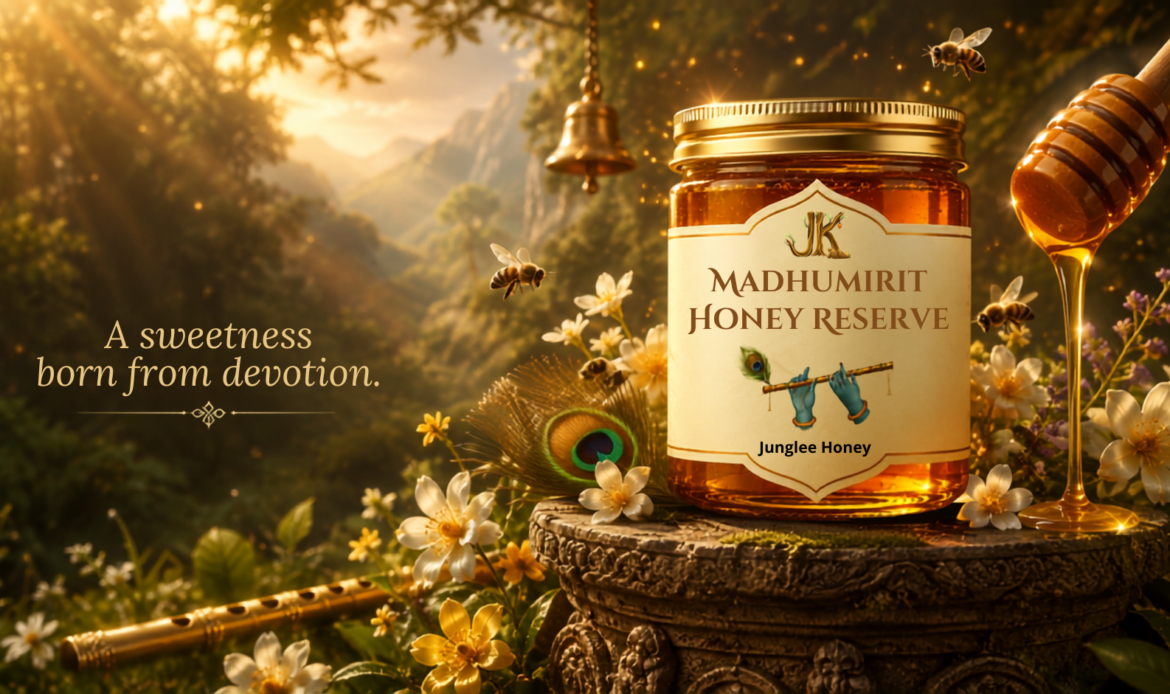
Madhumirit is a honey built around the idea of purity — sourced with care, kept as close to its natural state as possible, and offered with the same simplicity that has always defined honey at its best. Crafted by JK Junglee Honey, it is 100% pure forest honey, gathered from wild, untouched forest terrain rather than farmed or blended sources. It isn’t reinventing what honey is. It’s trying to protect what honey was always meant to be.
Where Nature Meets Devotion
Picture a landscape untouched by noise. Wildflowers stretching further than the eye can follow. Bees moving between blossoms with a rhythm that owes nothing to human instruction. Somewhere far off, if you listen closely enough, there’s almost a melody in it — the wind through tall grass, water moving over stone, the kind of quiet that feels less like silence and more like devotion expressed without words.
This is not a story about religion. It’s a story about a feeling that has always lived alongside Indian soil — the sense that nature is not something to be extracted from, but something to be met halfway, with patience and respect. The same instinct that once led people to offer the first flower of the season, or the first sip of milk, before taking any for themselves.
Honey, in that sense, has always been a kind of offering before it was ever a commodity. Something nature made freely, and something people learned to receive with a certain humility.
Madhumirit tries to hold on to that spirit — treating purity not as a marketing word, but as a form of quiet respect for where sweetness actually comes from.
Purity You Can Taste
Ask anyone who has tasted honey straight from a comb, unprocessed and unaltered, and they’ll tell you it’s a different experience entirely. The colour sits somewhere between amber and gold, catching light rather than blocking it. The texture is silky without being syrupy. The aroma carries traces of whatever flowers were nearby — sometimes floral, sometimes faintly earthy, never quite the same twice.
That inconsistency, strangely enough, is a sign of honesty. Nature doesn’t produce identical batches. It produces honest ones.
Madhumirit’s honey comes specifically from forest sources — hives found deep within wild terrain rather than cultivated apiaries lined up beside monoculture crops. That distinction matters. Forest honey carries the character of whatever the forest happens to be blooming with that season, unpredictable in the best way, and untouched by the kind of large-scale farming that often shapes commercial honey.
What does purity mean in honey?
Purity in honey means the least possible interference between the bee and the jar — no unnecessary processing, no added sugars, no shortcuts that trade authenticity for shelf appeal. It means the honey tastes, looks, and behaves the way honey naturally does, season to season.
Madhumirit is built around protecting that honesty, rather than smoothing it into something more “consistent” but less real.
Why Authenticity Matters in Honey
The honey market today is crowded with promises — “100% pure,” “farm fresh,” “raw and natural” — often printed on labels that mean very little once you look closer. Adulteration remains one of the honey industry’s oldest and most persistent problems, and most consumers have no easy way to verify what they’re actually buying.
What should consumers look for when buying authentic honey?
A few honest markers matter more than clever packaging: honey that crystallises naturally over time (a sign it hasn’t been over-processed), a source you can trace back to an actual region or apiary, and a brand willing to be transparent about how the honey reaches you rather than hiding behind vague claims.
Madhumirit is built on the belief that trust isn’t something a label can manufacture. It has to be earned, batch after batch, through consistency and honesty about the process.
That’s also why Madhumirit doesn’t ask for trust on faith alone. Each batch is lab-tested to verify its purity, and the honey carries doctor approval as part of its quality assurance — not as a medical claim, but as an additional layer of verification for people who want more than a promise printed on a label. In a category where “pure” is often just a word, JK Junglee Honey backs it with paperwork.
Madhumirit — More Than Just Honey
Strip away the poetry, and Madhumirit is still, simply, honey. But strip away the marketing instead, and what’s left is something closer to an idea: that sweetness worth having is sweetness that hasn’t been rushed. That purity is not just a claim on a jar, but a quiet standard someone chose to hold onto, even when shortcuts were easier.
Devotion, in the end, is not so different from that. It’s not loud. It doesn’t announce itself. It simply shows up, consistently, in the small decisions nobody else sees — choosing the harder, more honest way because it’s the right way.
That is the space Madhumirit hopes to occupy. Not a temple, not a claim to anything sacred — just an honest jar of honey, made with the kind of care that used to be assumed and now has to be chosen deliberately.
And maybe that’s the real reason honey has stayed close to people for as long as it has. It isn’t grand. It doesn’t ask to be remembered. It just shows up — in a spoon stirred into milk before bed, in a small gesture of care between two people, in the quiet hope that something this simple can still mean something. Madhumirit hopes to be that kind of presence in your home too.
Conclusion
Purity is something nature creates on its own, quietly, without asking for credit. Devotion is something the heart carries, often without words to explain it. Madhumirit exists in the space between those two things — not claiming to be more than honey, but hoping to be exactly as much as honey was always meant to be.
Somewhere, someone is stirring a spoonful into warm milk for a child who has a cold. Somewhere else, an elder is remembering a taste from decades ago and smiling at how little it has changed. That is what Madhumirit is really trying to hold onto — not a formula, but a feeling that has quietly passed from one hand to the next for longer than anyone can say.
Some sweetness fades the moment it touches the tongue. The kind Madhumirit hopes to offer is the kind that stays a little longer than that — long enough to remind you of someone who once loved you through a spoonful of honey.