
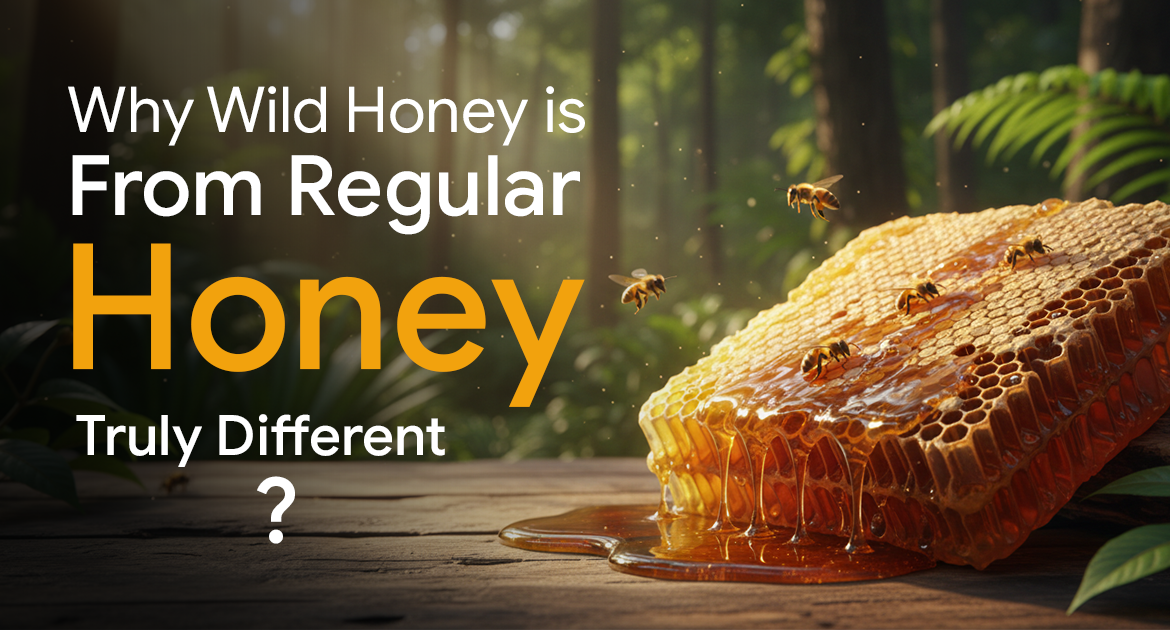
Why Wild Honey Is Truly Different from Regular Honey
Wild Honey may look identical once it’s sealed in a jar, yet its journey begins long before it reaches your spoon. Some honey forms slowly in forests, shaped by seasons and wild blossoms. Other honey comes from controlled environments, produced for speed and uniformity.
That difference goes far beyond appearance.
It defines the quality, character, and integrity of the honey itself.
Wild Honey Is Found in Nature, Not Created in Systems
Wild honey comes from bees that live freely in forests, mountains, and untouched landscapes. These bees choose their own nectar sources, feeding on wild herbs, medicinal plants, and seasonal flowers that grow without human cultivation.
In contrast, regular wild honey usually comes from managed bees kept near farms or monoculture crops. During low-nectar seasons, producers often feed these bees sugar syrup to maintain output.
As a result, wild honey follows nature’s rhythm.
Regular wild honey follows production schedules.
How Bees Live Shapes the Honey They Produce
Wild bees build hives in trees, rock crevices, and forest cavities. They move with the seasons and forage across diverse plant life. Because of this freedom, their honey reflects a wide range of botanicals.
Farmed bees often live in artificial hive boxes with limited access to flowers. Their restricted diet directly affects the quality of the honey.
Because wild bees roam freely, wild honey naturally offers:
Deeper, more complex flavor
Darker, naturally varying color
Stronger aroma
Greater nutritional diversity
You don’t just taste sweetness—you experience depth and character.
No Shortcuts Exist in the Wild
Wild honey remains close to its natural state. Producers do not heavily filter, overheat, or alter it to achieve visual perfection. Over time, it may crystallize. It may vary in color. Each batch may taste slightly different.
That variation signals authenticity.
On the other hand, regular honey often undergoes heating and processing to ensure consistency. While this creates a smooth appearance, it also reduces natural enzymes and nutrients.
Nature values purity, not perfection—and wild honey preserves exactly that.
Nutritional Strength Comes from Natural Diversity
Wild honey contains nectar collected from dozens of plant species, including medicinal herbs. This diversity enriches the wild honey with natural enzymes, antioxidants, and micronutrients.
Regular honey typically relies on one or two dominant floral sources. Consequently, its nutritional profile remains limited.
For this reason, wild honey feels richer, heavier, and more satisfying. It nourishes rather than simply sweetens.
Harvested with Care, Not Exploitation
Ethical wild honey harvesting requires skill, patience, and respect for nature. Responsible collectors take only what is necessary and leave enough wild honey for the bees to survive and thrive.
In contrast, commercial honey production often prioritizes volume over balance.
Wild honey respects the bees.
Regular honey often depends on maximizing them.
Why Wild Honey Costs More—and Why It’s Worth It
Wild honey cannot be rushed or mass-produced. It is seasonal, rare, and difficult to collect. Production depends entirely on nature’s timing.
Regular honey, however, is produced year-round with predictable output.
When you choose wild honey, you invest in:
- Authentic sourcing
- Sustainable practices
- Nutritional richness
- A slower, natural process
The price reflects integrity, not markup.
So, Which Honey Should You Choose?
If uniform sweetness and consistency matter most, regular honey may suit you.
However, if you value real taste, natural nutrition, and a genuine connection to nature, wild honey has no substitute.
Wild honey isn’t just food.
It’s the result of forests, flowers, bees, and balance working together.
According to food safety and nutrition research published by the “National Honey Board“, raw honey naturally contains enzymes and antioxidants that support overall wellness.
Final Thought
Not all honey is meant to be the same. Some wild honey is meant to stay wild.
By choosing wild honey, you choose honesty over polish, nature over shortcuts, and purity over convenience.
Because real honey doesn’t come from factories—it comes from the wild.